
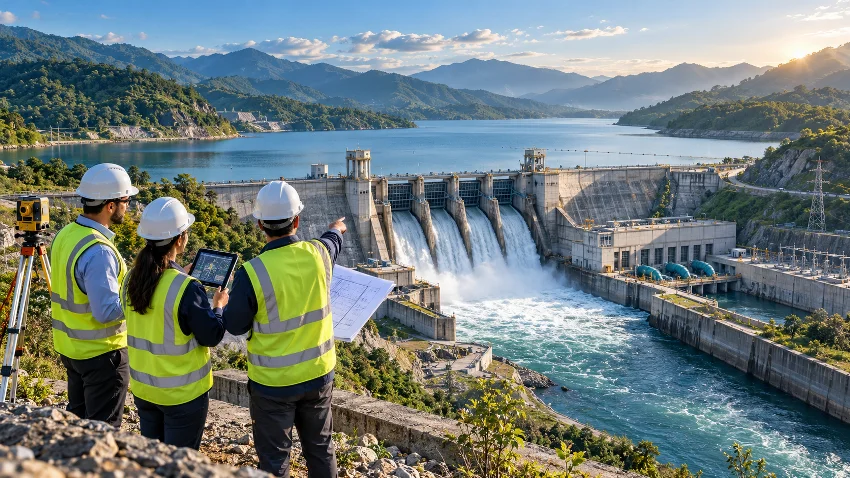
Water is one of the most powerful forces engineers work with. It can generate electricity, support entire cities, sustain agriculture, and reshape landscapes. But managing it safely requires far more than building pipes, dams, and drainage channels.
Modern Hydro Engineering combines fluid mechanics, advanced hydraulic modeling, infrastructure design, and environmental planning to solve increasingly complicated water challenges.
From urban flooding to aging reservoirs and changing rainfall patterns, engineers need systems that perform under both ordinary and extreme conditions. Understanding the science, design strategies, and emerging technologies behind water infrastructure helps organizations develop safer, more efficient, and sustainable solutions.
1. Understanding Advanced Hydro Engineering and Its Applications
Hydraulic engineering is a specialized field of civil engineering focused on the movement, control, storage, and distribution of water.
It applies fluid mechanics and hydrology to infrastructure such as rivers, canals, reservoirs, pipelines, pumping stations, drainage networks, and flood protection systems.
Advanced engineering approaches combine these traditional principles with computational modeling, automated monitoring, and environmental management.
The Relationship Between Hydrology and Hydraulics
Hydrology investigates how water moves through the natural environment.
It examines precipitation, infiltration, evaporation, groundwater recharge, surface runoff, and watershed behavior.
Hydraulics focuses on how water behaves while moving through natural channels and engineered structures.
For example, a hydrologist may estimate how much stormwater enters a river during extreme rainfall. A hydraulic engineer then evaluates how that discharge affects water levels, flow velocities, bridges, and nearby communities.
Both disciplines are essential for developing reliable water infrastructure.
Why Modern Water Systems Require Integrated Planning
Traditional infrastructure projects often concentrate on individual facilities.
A drainage network might be designed to remove stormwater, while a reservoir is managed primarily for water supply.
However, these systems are connected through broader watershed processes.
Expanding upstream drainage capacity can increase downstream flow peaks if runoff is transferred more quickly without adequate detention.
Similarly, reservoir operations can influence flood risk, water availability, and river ecosystems.
Integrated planning helps engineers understand these relationships before making expensive infrastructure decisions.
Engineering Challenges in Changing Environments
Urban development increases impervious surfaces such as roads, buildings, and parking areas.
These surfaces reduce natural infiltration and often increase stormwater runoff.
Meanwhile, climate variability can expose infrastructure to rainfall and drought conditions that differ from historical observations.
Engineers must evaluate uncertainty rather than assuming that past conditions will always represent future risks.
The objective is to create adaptable systems capable of maintaining acceptable performance under different environmental scenarios.
2. Hydraulic Design Principles for Efficient Water Flow
Hydraulic design begins with understanding the physical forces governing water movement.
Flow rate, pressure, velocity, friction, and energy losses influence nearly every water infrastructure project.
A reliable design must balance hydraulic efficiency with structural safety and operational requirements.
Continuity Equations and Flow Calculations
The continuity equation describes the relationship between flow velocity and cross-sectional area.
For steady, incompressible flow through a single section, the basic expression is:
Q = A × V
Where:
- Q = Discharge (m³/s)
- A = Cross-sectional flow area (m²)
- V = Average flow velocity (m/s)
Suppose a rectangular channel has a wetted cross-sectional area of 4 square meters and an average velocity of 2 meters per second.
The resulting discharge is 8 cubic meters per second.
Although this equation appears straightforward, actual channels involve changing water depths, turbulence, friction, and irregular boundaries.
Engineers must account for these conditions when estimating hydraulic capacity.
Applying Manning’s Equation to Open Channels
Manning’s equation is commonly used to estimate flow in open channels under appropriate assumptions.
In SI units, it can be expressed as:
V = (1/n) × R^(2/3) × S^(1/2)
Here, n represents Manning’s roughness coefficient, R is the hydraulic radius, and S is the energy slope.
The equation helps evaluate flow behavior in rivers, drainage channels, and engineered canals.
Surface characteristics strongly influence resistance.
A smooth concrete channel generally creates less friction than an irregular natural stream containing rocks, vegetation, and sediment deposits.
However, selecting the correct roughness coefficient requires engineering judgment and site-specific evaluation.
The U.S. Army Corps of Engineers provides detailed hydraulic calculation methods through its HEC-RAS technical documentation.
Pressure Flow and Energy Losses
Closed pipelines behave differently from open channels because they may operate under pressure.
Engineers often use the Bernoulli energy relationship alongside friction-loss equations to evaluate system performance.
The Darcy-Weisbach equation, for example, can estimate friction-related head loss:
h_f = f × (L/D) × (V²/2g)
In this relationship, f is the Darcy friction factor, L is pipe length, D is pipe diameter, V is velocity, and g is gravitational acceleration.
A longer pipeline or higher flow velocity can significantly increase energy losses.
These calculations influence pipe sizing, pump selection, and operating costs.
Engineers must also evaluate local losses from valves, bends, fittings, and other components.
Preventing Cavitation and Hydraulic Instability
Cavitation occurs when local liquid pressure falls sufficiently for vapor cavities to form.
As these cavities collapse in higher-pressure regions, they can damage pumps, turbines, valves, and other hydraulic equipment.
Poorly designed systems may also experience excessive vibration, unstable flow patterns, or damaging pressure transients.
Water hammer is another important concern, particularly when valves close rapidly or pumps stop unexpectedly.
Surge analysis and suitable protective devices help reduce these risks.
Reliable hydraulic design involves predicting not only average operating conditions but also unusual transient events.
3. Designing Modern Water Infrastructure Systems
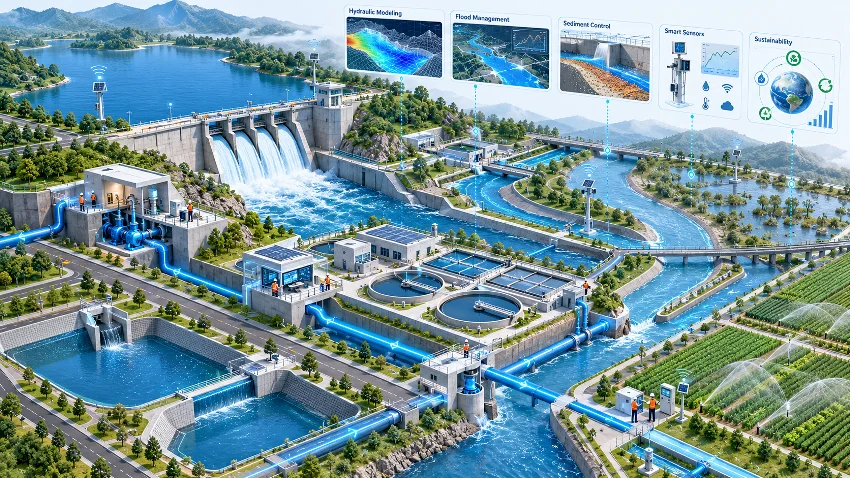
Water infrastructure includes interconnected physical assets that collect, transport, store, and regulate water.
Designing these assets requires consideration of hydraulic performance, structural integrity, operational reliability, and long-term maintenance.
Dams, Reservoirs, and Spillway Design
Dams provide water storage, flood regulation, hydropower generation, and other services.
Their design must account for foundation conditions, seepage, hydraulic loading, sediment accumulation, and extreme flood events.
Spillways are especially important because they allow excess reservoir water to pass safely downstream.
Insufficient discharge capacity or inadequate energy dissipation can create dangerous conditions.
The U.S. Bureau of Reclamation publishes engineering design standards addressing embankment dams, spillways, outlet works, and related hydraulic structures.
These standards emphasize the importance of engineering judgment and site-specific considerations.
For large projects, physical hydraulic models may supplement numerical simulations when flow patterns are unusually complicated.
Pipeline Networks and Pumping Stations
Urban water supply systems depend on pipelines, pumping facilities, pressure regulation, and storage reservoirs.
An effective distribution network must deliver sufficient flow while maintaining appropriate pressure.
Oversized equipment may increase capital costs, while undersized infrastructure can create reliability problems.
Pumping stations also represent important energy consumers.
Engineers evaluate pump curves, operating points, system head requirements, and variable-speed controls to improve performance.
For example, a variable-frequency drive can adjust pump speed when demand changes.
However, savings depend on system characteristics, operating conditions, and control strategy.
Irrigation Canals and Agricultural Water Management
Agricultural infrastructure must transport water efficiently across large areas while limiting unnecessary losses.
Canal design considers slope, channel geometry, sediment movement, infiltration, and operational control.
Lining canals can reduce seepage in suitable locations, although environmental and groundwater impacts require evaluation.
Automated gates and flow sensors may improve distribution accuracy.
Modern irrigation management also incorporates soil moisture information, crop water requirements, and seasonal water availability.
These practises support more informed allocation decisions where agricultural water demand competes with urban and environmental needs.
Asset Durability and Infrastructure Maintenance
Hydraulic infrastructure often operates for decades.
During that period, corrosion, abrasion, sedimentation, structural fatigue, and mechanical deterioration can reduce performance.
Designers should consider inspection access, repair procedures, replacement costs, and monitoring requirements from the beginning.
A lower construction cost does not automatically mean a lower lifetime cost.
Life-cycle engineering evaluates initial investment alongside operating expenses, maintenance requirements, and potential failure consequences.
4. Advanced Flood Modeling and Hydrological Risk Assessment
Flood management is among the most demanding applications of hydraulic engineering.
Extreme events involve changing flow conditions, uncertain rainfall patterns, complex terrain, and interactions between natural and artificial structures.
Numerical modeling allows engineers to examine possible outcomes before infrastructure is built.
One-Dimensional and Two-Dimensional Hydraulic Modeling
One-dimensional hydraulic models represent flow primarily along a defined channel direction.
They are useful for many river studies, channel capacity assessments, and water-surface profile calculations.
Two-dimensional models represent flow movement across a horizontal area.
This capability is particularly valuable for floodplains, urban intersections, and locations where water spreads in several directions.
HEC-RAS supports both 1D and 2D hydraulic modeling.
Its documentation provides guidance on terrain representation, computational methods, boundary conditions, and hydraulic calculations.
Selecting the appropriate approach depends on project complexity, data availability, computing resources, and required accuracy.
Developing Reliable Flood Simulations
A hydraulic model is only as useful as its underlying information and assumptions.
Engineers require terrain elevation data, channel geometry, boundary conditions, roughness estimates, and suitable hydrological inputs.
Where available, observed water levels and discharge measurements can support calibration.
For example, a model may predict peak flood levels during a historical storm.
Comparing predictions with recorded high-water marks helps engineers evaluate whether the simulation reproduces observed conditions.
However, good calibration against one event does not guarantee accurate predictions for every future flood.
Independent validation and sensitivity analysis remain important.
Understanding Flood Return Periods
Flood design frequently uses annual exceedance probabilities.
A flood with a 1% annual exceedance probability is commonly described as a 100-year flood.
This terminology doesn’t mean the event occurs exactly once every century.
Under a simplified assumption of independent years and constant annual probability, the chance of experiencing at least one such event within 30 years is:
P = 1 − (1 − 0.01)^30 ≈ 26%
This example demonstrates why long-term infrastructure planning should account for accumulated exposure.
Where rainfall patterns or watershed characteristics are changing, the assumption of constant annual probability may also require reconsideration.
Urban Stormwater Modeling
Urban catchments create additional challenges because buildings, roads, drainage structures, and underground networks interact.
The U.S. Environmental Protection Agency’s Storm Water Management Model, known as SWMM, supports simulation of runoff quantity and quality.
Engineers can examine how rainfall enters drainage systems, moves through pipes, and accumulates at critical locations.
Models may also evaluate detention facilities and combinations of conventional drainage infrastructure with green stormwater measures.
Simulation results help compare alternatives, although final designs must still satisfy local engineering requirements.
5. Sustainable Water Resource Management Strategies
Hydraulic efficiency is important, but sustainable water infrastructure must also protect ecological functions and maintain long-term resource availability.
Engineering decisions should consider environmental impacts alongside operational objectives.
Integrated Water Resources Management
Integrated water resources management recognizes that water supplies, land development, ecosystems, and economic activities are closely connected.
A river basin may support agriculture, municipal consumption, industry, electricity generation, and aquatic habitats.
Managing each demand independently can create avoidable conflicts.
Integrated approaches consider water availability, environmental requirements, operational priorities, and stakeholder interests.
UNESCO’s 2024 World Water Development Report emphasizes how water cooperation and effective management contribute to economic stability and social well-being.
Engineering solutions are therefore most effective when supported by coordinated institutions and transparent allocation policies.
Combining Green and Gray Infrastructure
Traditional gray infrastructure includes pipes, concrete channels, detention tanks, and engineered flood barriers.
Green infrastructure uses natural or nature-based processes to manage water.
Examples include rain gardens, constructed wetlands, permeable pavements, and vegetated drainage systems.
According to the U.S. EPA, green infrastructure can help manage stormwater close to its source while supporting water quality and reducing runoff.
A hybrid design might combine underground drainage pipes with upstream retention areas and vegetated infiltration facilities.
This configuration can reduce pressure on drainage networks during some rainfall events.
Its performance depends on soil conditions, available space, maintenance, rainfall intensity, and local hydrology.
Sediment Transport and River Ecosystem Protection
Water infrastructure can alter natural sediment movement.
Dams may trap sediment, reducing downstream supply and affecting channel morphology.
Meanwhile, excessive sediment accumulation can reduce reservoir storage capacity and interfere with hydraulic structures.
Sediment management strategies may involve controlled flushing, dredging, bypass systems, or watershed erosion reduction.
Each approach has operational and ecological trade-offs.
River engineering projects should also evaluate habitat connectivity, environmental flow requirements, and potential impacts on aquatic species.
Sustainable design seeks to balance infrastructure performance with the natural processes that maintain healthy river systems.
6. Digital Technologies and Smart Water Infrastructure

Digital technology is changing how engineers monitor, operate, and maintain hydraulic systems.
Rather than relying exclusively on periodic inspections and historical records, operators can increasingly access near-real-time information.
IoT Sensors and Remote Hydraulic Monitoring
Internet of Things sensors can measure water levels, pressure, flow velocity, equipment vibration, and other operational conditions.
For example, pressure sensors installed across a distribution network may help identify unusual changes associated with leaks or equipment problems.
River monitoring stations can provide continuous stage observations.
The U.S. Geological Survey explains how streamgages use stage measurements and stage-discharge relationships to estimate river flow.
However, reliable monitoring requires regular calibration and verification.
Sensors can drift, communication networks can fail, and inaccurate readings may lead to incorrect operational decisions.
Digital Twins for Water Systems
A digital twin is a digital representation of a physical asset or process connected to relevant operational data.
In water infrastructure, a digital twin may combine hydraulic models, sensor measurements, asset information, and operating conditions.
For example, engineers could use a pumping station model to examine equipment behavior under changing demand.
A reservoir digital twin might support the assessment of alternative operating scenarios.
The value comes from connecting simulation capabilities with current system conditions.
However, a realistic digital twin requires accurate data, appropriate model calibration, and clear maintenance responsibilities.
Without these foundations, sophisticated visualizations can create misleading confidence.
Predictive Maintenance and Asset Analytics
Predictive maintenance uses operational information to identify patterns that may indicate equipment deterioration.
Pump vibration, motor temperature, pressure fluctuations, and historical maintenance records can support condition assessment.
For example, unusual vibration trends may justify further inspection before a pump experiences a major failure.
Machine learning can assist with anomaly detection, but predictions should be evaluated against actual maintenance outcomes.
False alarms increase operational costs, while missed faults can create safety risks.
A practical strategy combines analytical tools with engineering expertise and established inspection procedures.
Automation and Cybersecurity Considerations
Water infrastructure increasingly relies on supervisory control and data acquisition systems.
These systems monitor equipment and may control pumps, gates, valves, and other facilities.
Remote connectivity improves operational flexibility but introduces cybersecurity concerns.
Organizations should establish secure access controls, network segmentation, system monitoring, and incident-response procedures.
Critical infrastructure automation should also include safe operating modes when communication or digital controls become unavailable.
Reliablity requires maintaining both cybersecurity and physical safety.
7. Optimizing Water Infrastructure Performance and Resilience
Long-term optimization involves more than increasing hydraulic capacity.
Engineers must consider energy consumption, service availability, maintenance expenses, environmental performance, and climate-related uncertainty.
Evaluating Hydraulic Efficiency
Hydraulic optimization begins by identifying where energy or water is being lost.
In distribution networks, these losses may result from pipe friction, leakage, poorly configured valves, or inefficient pumping.
Suppose a pumping system consumes 500,000 kWh annually.
If operational improvements reduce electricity consumption by 12%, annual savings would equal 60,000 kWh.
At an illustrative electricity price of $0.12 per kWh, that represents $7,200 per year.
Actual savings would depend on the local tariff, operating schedule, and verified energy measurements.
Climate Resilience and Adaptive Design
Infrastructure designed around historical conditions may face unfamiliar stresses during its operating life.
Longer drought periods, more intense rainfall events, sea-level rise, and changing sediment patterns can affect water systems differently.
Engineers should examine multiple plausible scenarios rather than selecting one future projection as certain.
Adaptive design may incorporate expansion space, flexible reservoir operating rules, replaceable equipment, or staged infrastructure investments.
This approach allows organizations to respond as new information becomes available.
Risk-Based Maintenance and Rehabilitation
Not every infrastructure asset has the same probability or consequence of failure.
Risk-based asset management evaluates deterioration, operational importance, exposure, and potential failure impacts.
For example, failure of a minor drainage inlet may cause localized inconvenience.
Failure of a major flood protection structure could have much more serious consequences.
Maintenance priorities should therefore reflect both asset condition and failure consequences.
Structured risk assessments help organizations allocate limited rehabilitation budgets more effectively.
Developing a Long-Term Water Management Roadmap
A practical infrastructure roadmap begins with an assessment of existing systems.
Engineers identify capacity constraints, maintenance backlogs, operational inefficiencies, and environmental risks.
The next stage involves comparing improvement options using engineering feasibility, economic analysis, and resilience criteria.
Pilot projects and monitored upgrades can help validate new technologies before wider deployment.
Regular performance reviews ensure that infrastructure strategies adapt to changing demands.
The strongest water systems are not necessarily those with the largest structures, but those that consistently deliver safe, efficient, and dependable services.
Advanced Hydro Engineering connects hydraulic science, resilient infrastructure design, digital monitoring, and sustainable water management. From flood simulations to efficient pumping networks, successful projects depend on reliable data, sound engineering judgment, and long-term planning.
As environmental conditions and infrastructure demands evolve, organizations should reassess existing systems and prioritize practical improvements.
Curious about different perspectives on the subject? Discover insights through additional reading materials and relevant external references. Exploring related discussions can reveal interesting connections, introduce new ideas, and provide useful context that complements the information shared in this article.
GetMobilePrices.com ⭒ Routerlinksyssmartwifi.com ⭒ Fikretorman.online ⭒ TheNorthpoleBar.co.uk ⭒ SingleSmokers.co.uk ⭒ Stromectol1h.top ⭒ Eclector.co.uk ⭒ KetoPremiere.cc ⭒ Atozmp3.ws ⭒ Bside-rock.com ⭒ Ukinvestmentadvice.co.uk ⭒ Buzfeed.org ⭒ MakerFieldSpring.co.uk ⭒ WhiteSwillWinParty.org ⭒ VisitLizardCornwall.co.uk ⭒ Big-HeadBasketball.com ⭒ VideoReview.ws ⭒ Woodstock-Exhibition.com ⭒ Ispaziorepository.com ⭒ Accesschc.org ⭒ Hydrophil.biz ⭒ SilentKnightsSoaring.org ⭒ RestorerMinistries.org ⭒ Bodybuilding-Blog.org ⭒ Davidsavillphotography.co.uk ⭒ BetterSingingVoice.com ⭒ 1kdailyprofit-official.com ⭒ JainSonUmbrella.com ⭒ Vr7uallms.com ⭒ Dz-Recrute.com ⭒ CuisineMetisse.com ⭒ Alphabetnyc.com ⭒ ProjectThinIce.org ⭒ Lympleylodge.co.uk ⭒ AmbProductions.co.uk ⭒ Johnpowellavs.co.uk ⭒ DakarRally.co.uk ⭒ Dumbletoncc.co.uk ⭒ BaconFromAcorns.com ⭒ LogMe.cyou ⭒ Ffmovies.cyou ⭒ Daily-News.cyou ⭒ AirTechNow.cyou ⭒ Avideo.cyou ⭒ OpenLoad.cyou ⭒ OwnerFinancing.cyou ⭒ Variable-Annuity.cyou ⭒ GoodBrand.cyou ⭒ InvestFutureNow.cyou ⭒ OceanBreeze.cyou ⭒ JustSummer.cyou ⭒ OneTech.cyou ⭒ Naturelv.cyou ⭒ DepositRetiree.cyou ⭒ CuteEye.cyou ⭒ NextVision.cyou ⭒ LordMovies.cyou ⭒ Excited.cyou ⭒ Exporelab.cyou ⭒ Supav.cyou ⭒ Astro.edu.pl ⭒ BeSmart.edu.pl ⭒ Biology.edu.pl ⭒ Bmi.edu.pl ⭒ Cent.edu.pl ⭒ Chemistry.edu.pl ⭒ Cholesterol.edu.pl ⭒ Cooking.edu.pl ⭒ Daily.edu.pl ⭒ Dance.edu.pl ⭒ Dental.edu.pl ⭒ Diet.edu.pl ⭒ Doctor.edu.pl ⭒ Econom.edu.pl ⭒ Engine.edu.pl ⭒ Fashion.edu.pl ⭒ Films.edu.pl ⭒ ForexForum.edu.pl ⭒ Games.edu.pl ⭒ Halkali.edu.pl ⭒ Hazard.edu.pl ⭒ HealthCollege.edu.pl ⭒ Journal.edu.pl ⭒ Kidsfun.edu.pl ⭒ Kila.edu.pl ⭒ Laws.edu.pl ⭒ Lets-Talk.edu.pl ⭒ Life.edu.pl ⭒ lifestyle.edu.pl ⭒ MakeupArt.edu.pl ⭒ Mid.edu.pl ⭒ Mil.edu.pl ⭒ Natural.edu.pl ⭒ Neural.edu.pl ⭒ NeuroSoft.edu.pl ⭒ Oak.edu.pl ⭒ Olza.edu.pl ⭒ Partner.edu.pl ⭒ PatoLogia.edu.pl ⭒ Philosophy.edu.pl ⭒ Podcast.edu.pl ⭒ Poker.edu.pl ⭒ PolisHighschool.edu.pl ⭒ Preceptor.edu.pl ⭒ Promotor.edu.pl ⭒ Psico.edu.pl ⭒ Sena.edu.pl ⭒ Social.edu.pl ⭒ WebNet.edu.pl ⭒ Wf.edu.pl ⭒ Work.edu.pl ⭒ Nowa.edu.pl ⭒ Sylva.edu.pl ⭒ Study.edu.pl ⭒ Slub.edu.pl ⭒ Nus.edu.pl ⭒ Unr.edu.pl ⭒ Umd.edu.pl ⭒ Upm.edu.pl ⭒ Tell.edu.pl ⭒ Vibes.oo.gd ⭒ Meetup.cc.nf ⭒ Discover.es.ht ⭒ Daily.ar.nf ⭒ Creative.in.nf ⭒ Style.it.nf ⭒ Fairy.mx.nf ⭒ Likeable.ro.nf ⭒ Mindset.ru.nf ⭒ Future.uk.nf ⭒ Genz.webs.nf ⭒ Truly.oo.gd ⭒ Dreamy.cc.nf ⭒ Scope.es.ht ⭒ Journey.ar.nf ⭒ Inspire.in.nf ⭒ Growth.it.nf ⭒ Rogue.ru.nf ⭒ Mint.uk.nf ⭒ Looks.webs.nf ⭒ Hub.oo.gd ⭒ Sight.cc.nf ⭒ Focus.es.ht ⭒ Digest.ar.nf ⭒ Flow.in.nf ⭒ Explore.it.nf ⭒ Ideas.mx.nf ⭒ Stories.ro.nf ⭒ Wisdom.ru.nf ⭒ Vision.uk.nf ⭒ Ost.webs.nf ⭒ Mart.oo.gd ⭒ Pulse.cc.nf ⭒ Prime.es.ht ⭒ Trend.in.nf ⭒ Advice.it.nf ⭒ Learn.mx.nf ⭒ Right.ro.nf ⭒ Wave.uk.nf ⭒ Nova.webs.nf ⭒ LifeSpace.cc ⭒ Witrynki.com.pl ⭒ Rsn.org.pl ⭒ Igg.org.pl ⭒ GoodStory.org.uk ⭒ AdPoint.co.za ⭒ Lvs.co.in ⭒ Gorank.biz.in ⭒ Budget.com.de ⭒ Muse.com.de ⭒ Viva.com.de ⭒ Cove.com.in ⭒ Cozy.com.in ⭒ Digi.com.in ⭒ Se.net.pl ⭒ Caz.edu.pl ⭒ Erz.edu.pl ⭒ E-book.com.pl ⭒ Total.org.pl ⭒ War.net.pl ⭒ Deko.my.id ⭒ Urbans.my.id ⭒ Citi.my.id ⭒ Kicks.my.id ⭒ Rings.my.id ⭒ Edus.my.id ⭒ Seeks.my.id ⭒ More.my.id ⭒ Reads.my.id ⭒ Finds.my.id ⭒ Words.my.id ⭒ Style.my.id ⭒ Mivo.my.id ⭒ Jelio.my.id ⭒ Zavi.my.id ⭒ Inspiro.my.id ⭒ Stylio.my.id ⭒ Trips.my.id ⭒ Trave.my.id ⭒ Move.my.id ⭒ Lane.my.id ⭒ Theory.my.id ⭒ Mosaic.my.id ⭒ Locale.my.id ⭒ Essence.my.id ⭒ Virela.my.id ⭒ Laluna.my.id ⭒ Evina.my.id ⭒ Zevora.my.id ⭒ Kultur.my.id ⭒ Pins.web.id ⭒ Tick.web.id ⭒ Netter.web.id ⭒ Pops.web.id ⭒ Cosmo.web.id ⭒ Huge.web.id ⭒ Minds.web.id ⭒ Reds.web.id ⭒ Techs.web.id ⭒ Meds.web.id ⭒ Arts.web.id ⭒ Mobi.web.id ⭒ Zelo.web.id ⭒ Lifes.web.id ⭒ Piknik.web.id ⭒ Tripy.web.id ⭒ Fins.biz.id ⭒ Deeps.biz.id ⭒ Dots.biz.id ⭒ Teen.biz.id ⭒ Gens.biz.id ⭒ Revo.biz.id ⭒ Tekun.biz.id ⭒ Hubs.biz.id ⭒ Spotiva.biz.id ⭒ Startiva.biz.id ⭒ Inves.biz.id ⭒ Biznex.biz.id ⭒ Growin.biz.id ⭒ Mufa.biz.id